Reverse Osmosis vs. Whole House Filters: 2026 Guide
Reverse Osmosis vs. Whole House Filters: 2026 Complete Comparison
You've decided tap water needs help — but now you're staring down two very different solutions with a $600 price gap between them. Reverse osmosis systems promise to scrub out virtually every dissolved contaminant, while whole house water filters protect every faucet, shower head, and appliance under your roof. Neither claim is wrong, but they solve different problems. This guide cuts through the marketing to show you exactly which system fits your water, your budget, and your household.
Why the Confusion Exists
The water filtration industry doesn't help itself. Whole house filters are often marketed as "complete protection," while reverse osmosis systems are sold as the ultimate solution. Both are technically accurate — in narrow, specific scenarios. The problem is that most buyers don't know what's actually in their water, and the two systems target almost entirely different contaminants.
Whole house filters are point-of-entry (POE) systems: they connect to your main water line and treat every drop that enters your home. They use sediment filters and activated carbon to remove chlorine, chloramines, sediment, and volatile organic compounds (VOCs). The result is water that tastes and smells better from every tap — including your shower, which matters more than most people realize since chlorine absorbs through skin and off-gases during hot showers.
Reverse osmosis is a point-of-use (POU) technology. An RO system sits under your kitchen sink (or on your countertop) and forces water through a semi-permeable membrane rated at 0.0001 microns. That's roughly 500 times finer than a whole house carbon filter. The tradeoff: it only treats water at one location, and it produces water slowly — typically via a holding tank or a modern tankless design.
Understanding which contaminants you're actually dealing with is the single most important step before buying either system. Check your annual water quality report from your utility, or request a water test from a certified lab.
What Each System Actually Removes
This is the table the marketing brochures skip:
| Contaminant | Whole House Carbon Filter | Reverse Osmosis |
|---|---|---|
| Chlorine / Chloramines | ✅ Excellent | ✅ Yes |
| Sediment / Turbidity | ✅ Excellent | ✅ Yes |
| VOCs (benzene, toluene) | ✅ Good | ✅ Yes |
| PFAS "forever chemicals" | ❌ Limited | ✅ 95–99% |
| Lead | ❌ Limited* | ✅ 95–99% |
| Fluoride | ❌ No | ✅ 90–96% |
| Nitrates / Nitrites | ❌ No | ✅ 85–95% |
| Arsenic | ❌ No | ✅ 95%+ |
| Chromium-6 | ❌ No | ✅ 95%+ |
| Bacteria / Cysts | ❌ No (most systems) | ✅ with UV add-on |
| Hardness / Scale | ❌ No (carbon) | ✅ Yes |
| Taste & Odor | ✅ Excellent | ✅ Excellent |
*Some whole house systems include specialty lead-reduction media, but this is not standard.
The pattern is clear: if dissolved inorganic contaminants — PFAS, fluoride, nitrates, arsenic — are your concern, only reverse osmosis reliably addresses them. If chlorine, sediment, and general taste are the issue, a whole house carbon filter is sufficient and far cheaper.
What to Look for Before You Buy
Filtration Micron Rating
This single number explains most of the difference between the two technologies. Whole house carbon filters typically operate at 5–25 microns — effective against particles, sediment, and chemical compounds that bind to carbon, but physically incapable of blocking dissolved ions. RO membranes work at 0.0001 microns, small enough to block individual molecules. When a contaminant is dissolved (i.e., it has broken apart into ions in water), only RO or distillation will remove it.
Flow Rate vs. Purification Speed
A whole house filter runs at 8–15 gallons per minute (GPM) — enough to run a shower, dishwasher, and washing machine simultaneously without pressure loss. An under-sink RO system produces water at 50–800 gallons per day (GPD), but that figure is misleading: it measures maximum output spread across 24 hours. A 400 GPD unit fills a standard glass in roughly 15 seconds. For drinking and cooking, that's plenty. For filling a bathtub, it's impractical — which is why whole-home RO systems (designed for POE use) cost $5,000–$15,000 and remain a niche product.
Water Waste Ratio
Older RO systems discard 3–4 gallons of wastewater for every 1 gallon of purified water. Modern tankless systems have improved dramatically — premium units now achieve a 1:1 ratio or better. If you're in a drought-prone region or on a well with limited yield, this matters. Whole house carbon filters produce no wastewater at all.
Installation Complexity
Whole house filters require cutting into the main water line, adding shutoff valves, and ideally a bypass loop — typically a 2–4 hour job for a plumber at $150–$300 in labor. Under-sink RO systems connect to existing supply lines under your kitchen sink; most include detailed instructions and require no special tools. Many homeowners install them in under an hour.
Maintenance Costs
Both systems need annual filter replacements. Whole house filter cartridges run $50–$150 per year. RO systems need pre-filter and post-filter changes ($40–$80/year) plus membrane replacement every 2–5 years ($30–$60). The RO membrane is the most critical and often most overlooked maintenance item.
Reverse Osmosis vs. Whole House Filters: Our Top Picks for 2026
| Model | Type | Best For | Removal | Price |
|---|---|---|---|---|
| iSpring RCC7AK | Under-sink RO | Most households, budget pick | 99%+ contaminants | ~$219 |
| Waterdrop G3P800 | Under-sink RO | Fast flow, small cabinet | 99%+ contaminants | ~$369 |
| AquaTru Carafe | Countertop RO | Renters, no plumbing | 99%+ contaminants | ~$299 |
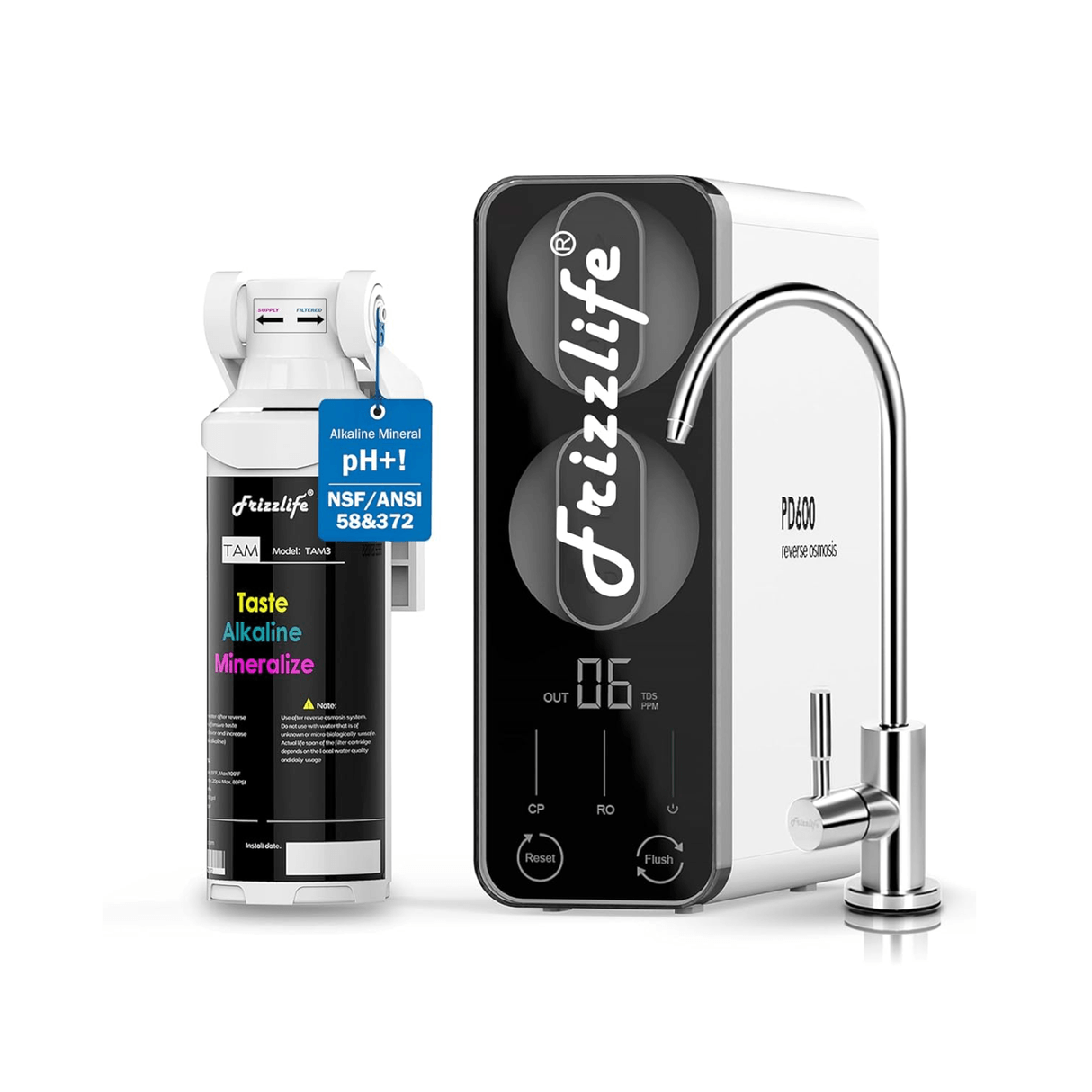
| Frizzlife PD-600-TAM3 | Under-sink RO | Compact, tankless | 99%+ contaminants | ~$249 |
| SpringWell CF1 | Whole house | City water, chlorine/VOC | Sediment, Cl, VOCs | ~$895 |
| Aquasana EQ-1000 | Whole house | Hard water + chlorine | Sediment, Cl, scale | ~$999 |
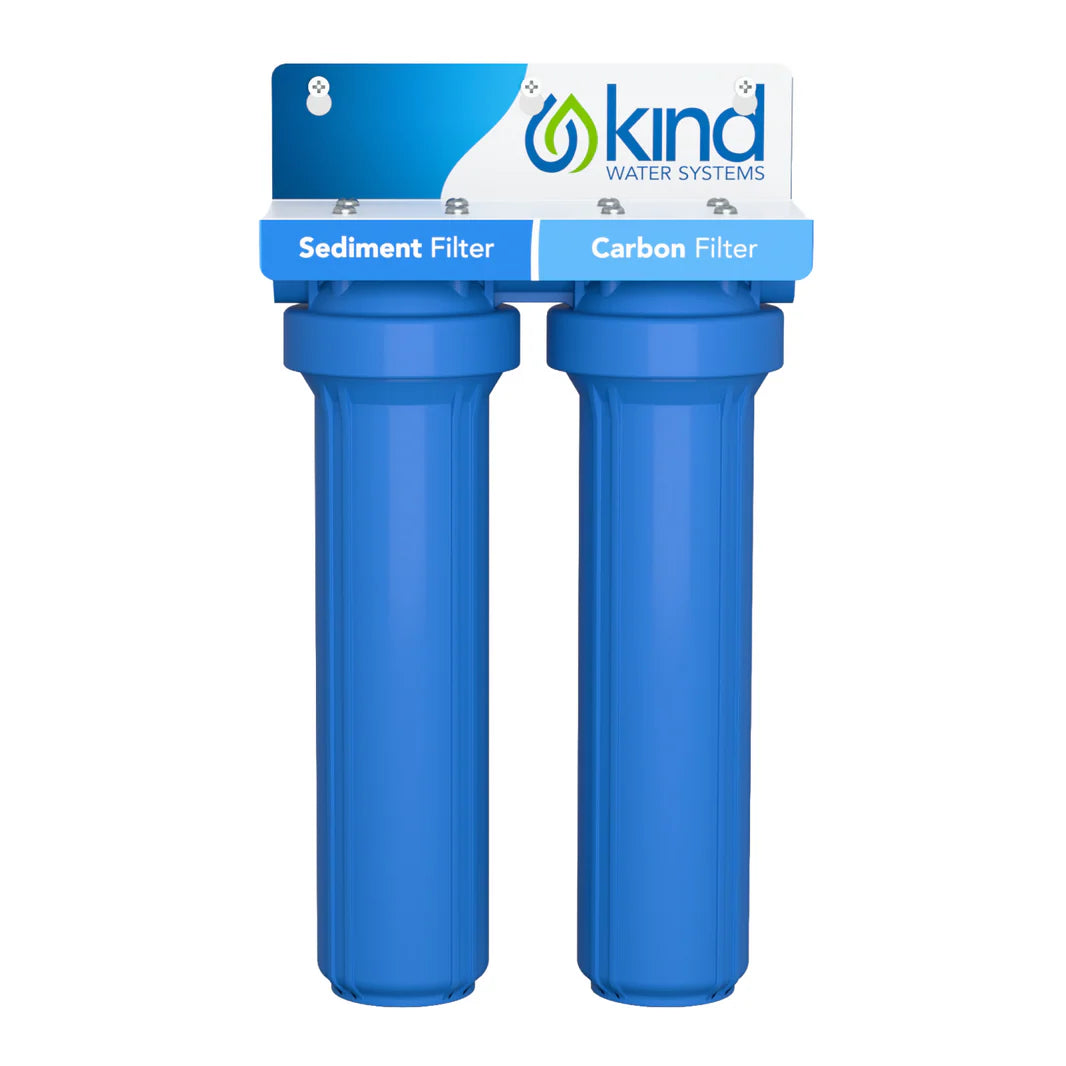
| Kind E-1000 | Whole house | Budget whole-house | Sediment, Cl, VOCs | ~$599 |
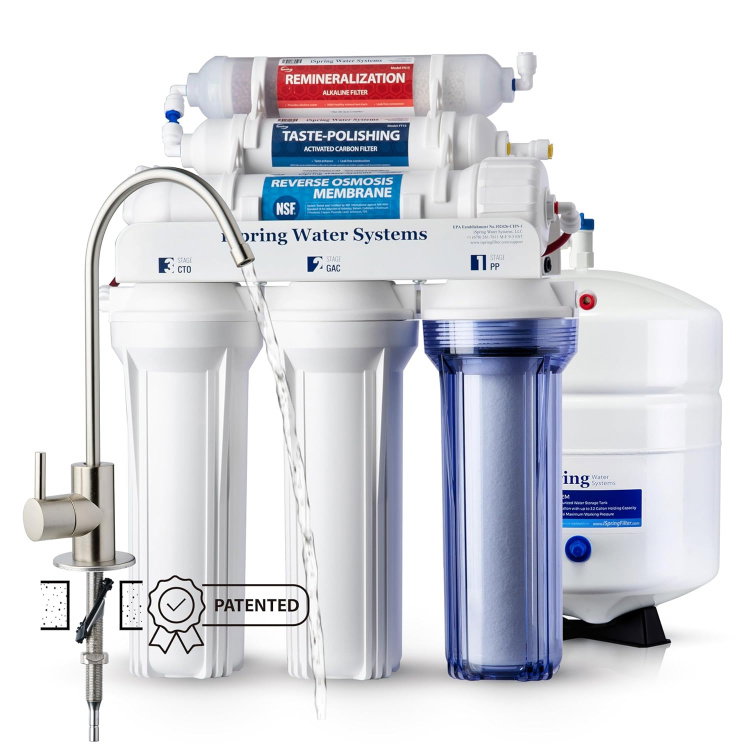
iSpring RCC7AK (~$219)
The iSpring RCC7AK is the standard-setter for budget-minded RO buyers, and for good reason. It's NSF/ANSI 58 certified, removes 99%+ of over 1,000 contaminants, and adds an alkaline remineralization stage that puts calcium, magnesium, and potassium back into purified water. The result tastes far better than flat-tasting standard RO output — a complaint common to cheaper systems.
Installation takes 60–90 minutes and requires no special tools. The unit stores purified water in a 3.2-gallon pressurized tank under the sink. That tank is the only real downside: it takes up cabinet space and needs to be sanitized annually. The pre-filters and post-filters need annual replacement (roughly $55/year); the membrane lasts 2–3 years under typical use.
For households concerned about PFAS, lead, fluoride, or nitrates — and who primarily want clean drinking and cooking water — this is the value benchmark.
Best for: Most households on city water seeking proven PFAS and lead removal on a budget.
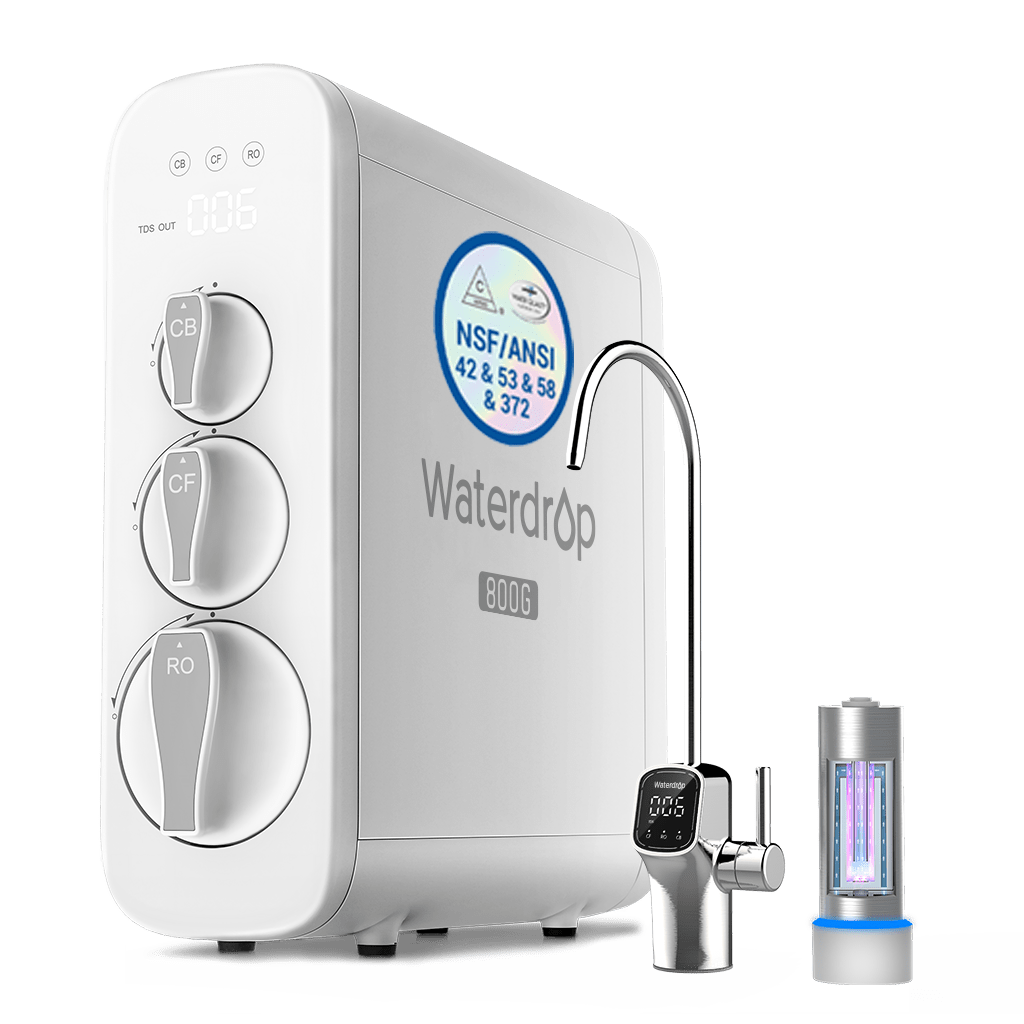
Waterdrop G3P800 (~$369)
The G3P800 is Waterdrop's flagship under-sink system, and the 800 GPD output is genuinely impressive — it fills a standard glass in about 8 seconds with no tank delay. The tankless design means no pressurized reservoir under the sink, just a compact inline unit that delivers water on demand through a dedicated faucet.
A built-in TDS meter on the faucet lets you monitor water quality in real time. The composite filter design simplifies maintenance to one or two cartridge swaps per year instead of the three separate cartridge changes required by traditional tank-based systems. The RO membrane is rated for 2 years. At $369, it commands a premium over tank-based systems, but the faster flow and cleaner cabinet setup justify the difference for many buyers.
One note: like all under-sink RO systems, this treats only the kitchen tap. Shower water and laundry water remain unfiltered — which is fine unless you have specific skin or scale concerns.
Best for: Households that want instant flow and a clean cabinet; ideal for medium to large families.
AquaTru Carafe (~$299)
Not every household can cut into supply lines. Renters, apartment dwellers, and anyone who wants zero-plumbing installation should look at the AquaTru Carafe — a countertop RO system that plugs into a standard outlet and filters water on demand. IAPMO certified and NSF/ANSI 58 compliant, it removes 99%+ of PFAS, nitrates, fluoride, and lead without touching your pipes.
The tradeoff is throughput: the Carafe processes roughly 1 liter per cycle and stores up to 2.5 liters. For a single person or couple who primarily want clean drinking water, that's ample. For a family of four drinking multiple liters per day, the refill frequency becomes a minor chore. No installation costs and portability at moving time offset the per-gallon inconvenience.
Best for: Renters, apartments, travel, or anyone who can't install an under-sink system.
Frizzlife PD-600-TAM3 (~$249)
The Frizzlife PD-600-TAM3 sits in an appealing middle ground: tankless convenience at a price closer to tank-based systems. At 600 GPD, it delivers water quickly enough that the absence of a storage tank is rarely noticeable. The compact footprint is genuinely useful in tight under-sink cabinets — it measures roughly half the footprint of most tank systems.
The three-stage design includes a PP sediment pre-filter, an RO membrane, and a carbon post-filter. Certification covers NSF/ANSI 58 for the membrane stage. Filter life is rated at 12 months for pre/post filters and 24 months for the membrane, consistent with the category. At $249, it undercuts the Waterdrop G3P800 meaningfully while still delivering tankless speed.
Best for: Buyers who want tankless convenience without paying flagship prices; small kitchens.
SpringWell CF1 (~$895)
The SpringWell CF1 is the whole house pick for most city-water homes. A three-stage system — KDF media, catalytic carbon, and sediment — it handles chlorine, chloramines, sediment, pesticides, and VOCs across a rated 9 GPM flow rate with a 1,000,000-gallon filter life (roughly 5–7 years for the average household). The high flow rate means no pressure drop even during peak usage.
Installation is straightforward relative to the category, with clear instructions and a lifetime warranty on tanks and valves. The CF1 does not soften water or remove hardness minerals, and it does not address fluoride, nitrates, or PFAS — for those, pair it with an under-sink RO at the kitchen tap. That combination covers virtually every water quality concern a city-water household is likely to encounter.
Best for: City-water homes with chlorine, chloramines, or VOC concerns; excellent as half of a whole-house + RO dual setup.
Aquasana EQ-1000 (~$999)
The Aquasana EQ-1000 distinguishes itself with a salt-free scale inhibitor built into the system — an SCM (Scale Control Media) stage that conditions hardness minerals so they don't form scale deposits on pipes and appliances, without removing the minerals or using salt. For households in hard-water regions who don't want a traditional salt-based softener, this is a meaningful advantage.
Rated at 10 GPM and 1,000,000 gallons, the EQ-1000 covers chlorine, chloramines, sediment, and VOCs. A UV filter add-on is available for well water users who want bacteria protection. Like all whole house carbon systems, it does not remove dissolved inorganic contaminants — PFAS, fluoride, nitrates remain in the water unless addressed by a downstream RO system.
Best for: Hard-water households on city supply; buyers who want chlorine + scale control in one unit.
Kind E-1000 (~$599)
The Kind E-1000 makes a whole house filter accessible without the near-$1,000 outlay of premium systems. It delivers 15 GPM — higher than most competitors — and uses a catalytic carbon + KDF stage that handles chlorine, chloramines, hydrogen sulfide, iron, and some heavy metals. The filter life is rated at 1,000,000 gallons, similar to more expensive units.
The lower price comes with trade-offs: no salt-free softener stage, and installation requires more attention to thread fittings. But for households primarily concerned with chlorine and taste — particularly those who've decided against an RO system — the Kind E-1000 delivers whole-house protection at a price that's easier to justify. Check your local water quality report at vivavenly.com before purchasing to confirm this covers your specific contaminants.
Best for: Budget-conscious buyers who want whole-house chlorine and sediment removal.
The Dual System Strategy
Many households ultimately land on running both: a whole house filter to protect pipes, appliances, skin, and shower water from chlorine and sediment, combined with an under-sink RO at the kitchen tap for drinking and cooking water. This covers every practical water quality concern most city-water homeowners face.
The math works out better than you'd expect. A whole house filter costs $600–$1,000 upfront; an under-sink RO adds $200–$370. Total outlay: $800–$1,370 — comparable to some premium single whole-house systems, but with dramatically broader contaminant coverage. The whole house filter also extends RO membrane life by handling the sediment and chlorine load before water reaches the RO unit.
If this approach suits your situation, pair the Kind E-1000 (whole house) with the iSpring RCC7AK (RO) for the most cost-efficient dual setup at around $820 total.
Frequently Asked Questions
Do I need both a whole house filter and a reverse osmosis system?
Not necessarily, but the combination is often the best long-term solution. A whole house filter protects skin, appliances, and plumbing from chlorine and sediment. An under-sink RO handles dissolved contaminants — PFAS, fluoride, nitrates — that carbon filters cannot remove. If your only concern is taste and chlorine, a whole house filter alone may be sufficient.
Does reverse osmosis remove PFAS "forever chemicals"?
Research indicates that reverse osmosis removes 95–99% of PFAS compounds. It is among the most effective residential technologies for PFAS reduction, alongside activated carbon block filters rated specifically for PFAS. Whole house carbon filters provide only limited PFAS removal and are not reliably effective for this contaminant class.
How much water does an RO system waste?
It depends on the system. Older RO systems waste 3–4 gallons per gallon purified. Modern tankless systems have improved significantly — premium units achieve a 1:1 ratio or better. For a typical household drinking 2–3 gallons of purified water per day, a modern RO system wastes roughly 2–3 gallons per day — about one extra toilet flush worth of water.
Will a whole house filter remove fluoride?
Standard whole house carbon filters do not remove fluoride. Fluoride is a dissolved ion that carbon media cannot trap at typical flow rates. If fluoride removal is a priority, an under-sink reverse osmosis system is the standard residential solution, removing 90–96% of fluoride at the tap.
Can I install an under-sink RO system myself?
Most under-sink RO systems are designed for DIY installation and include all necessary fittings and tubing. The typical installation connects to the cold water supply line under the sink, runs a drain line to the sink drain, and mounts a dedicated faucet through a hole in the sink deck. The process takes 60–90 minutes for most people and requires no special tools.
How often do RO filters and membranes need replacing?
Pre-filters and post-carbon filters typically need annual replacement, costing $40–$80 per year depending on the system. The RO membrane itself lasts 2–5 years under normal use. Systems with a built-in TDS meter make it easy to monitor membrane performance — a rising TDS reading signals the membrane is degrading and needs replacement.
Shop these picks
Related guides