Best White Noise Machines for Deep Sleep 2026
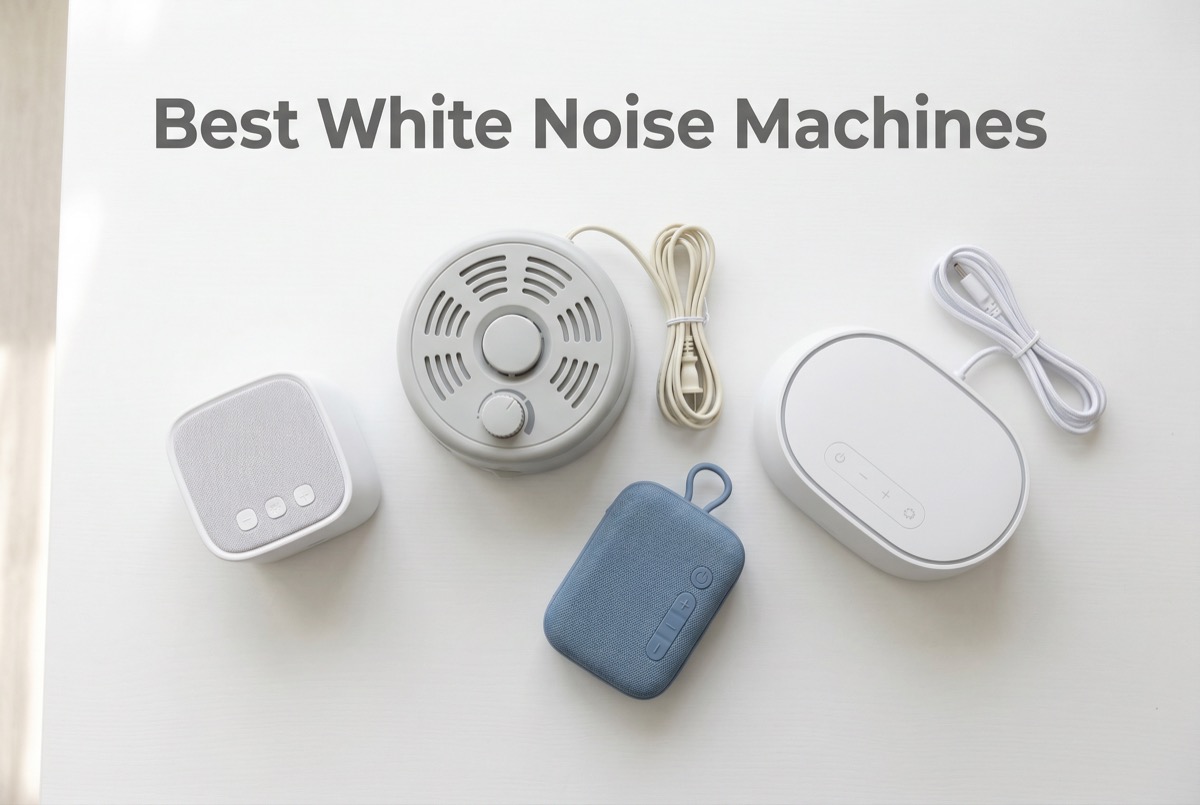
Best White Noise Machines for Deep Sleep 2026: 7 Picks for Every Sleeper
Street noise, a snoring partner, early-morning birds — the list of things that break sleep is long, and most of them are completely outside your control. White noise machines change that equation. By layering a steady, neutral sound over your environment, they mask the spikes that jolt you out of deep sleep before your brain even registers them consciously. This guide covers the seven best white noise machines in 2026 — tested, ranked, and matched to specific sleeper types — along with everything you need to know to choose the right one. Browse our sleep environment guides for more on building a restful bedroom.
Why Sound Masking Matters for Deep Sleep in 2026
Sleep research suggests that white noise works not just by covering disruptive sounds, but by creating an acoustic environment that mirrors the relative quiet your brain expects during deep sleep stages. When external sounds are inconsistent — a door slamming, traffic surging, a neighbor's television — your brain has to make a quick threat-assessment decision each time. White noise smooths that variability, reducing how often those micro-assessments pull you back toward wakefulness.
The demand for better sleep environments has surged in 2026. Multisensory bedroom design — pairing controlled sound with adjusted lighting and temperature — has become the dominant framework in sleep wellness, displacing the gadget-heavy tracking approach of earlier years. Sound machines are central to that shift. They're also one of the simplest, most immediate interventions you can make: plug in, set a volume, and the effect is immediate.
There are real safety guidelines worth following. Experts recommend keeping your machine at or below 50 decibels — roughly the volume of a quiet conversation — and placing it at least a few feet from your bed rather than directly on the pillow. At those levels, the benefits are real and the risks negligible.
What to Look for in a White Noise Machine
Sound Type: White, Pink, Brown — and Real Fan Noise
"White noise" has become a catch-all term, but there are meaningful differences between sound types. True white noise contains equal energy across all frequencies — it's the harsh, static-like hiss you might remember from an analog TV. Many people find it grating over a full night.
Pink noise reduces the energy in higher frequencies, resulting in a softer, more natural sound — rain, ocean, rustling leaves all approximate pink noise. Brown noise goes even lower, with a deep rumble resembling rushing water or a powerful fan. Research suggests pink and brown noise may be more conducive to deep sleep for many people than true white noise, though individual response varies widely.
Mechanical fan machines — like the Yogasleep Dohm and SNOOZ — occupy their own category entirely. They use a real spinning fan inside a housing to produce genuine airflow sound. Many sleepers find this the most natural and least fatiguing option because it has none of the digital artifacts that even the best recorded sounds carry.
Non-Looping Audio
This is the most important technical specification most buyers overlook. Budget machines often play a short recorded clip — sometimes as short as 30 seconds — on a continuous loop. Your conscious mind might not notice, but research suggests the brain detects the repeating pattern and can begin anticipating the loop, keeping you in lighter sleep stages. A good white noise machine plays either truly randomized audio or a long enough track that looping is imperceptible. Always check whether a machine's sounds are non-looping before buying.
Volume Range
A machine that tops out at moderate volume is nearly useless for city dwellers, people who sleep near a busy road, or anyone dealing with a snoring partner. Look for machines that specify a maximum decibel output of at least 75–80 dB — not because you'll use it that loud, but because having headroom means you can set a comfortable level and still effectively mask loud intrusions. The LectroFan EVO is the benchmark here, covering an unusually wide dynamic range for its price.
Best White Noise Machines 2026: Our Top Picks
| Model | Best For | Sound Type | Looping | Price |
|---|---|---|---|---|
| LectroFan EVO | Most sleepers | Digital fan + white noise | Non-looping | ~$45 |
| Yogasleep Dohm Classic | Natural sound fans | Real mechanical fan | N/A (live) | ~$45 |
| Hatch Restore 3 | All-in-one system | Smart soundscapes | Non-looping | ~$150 |
| SNOOZ | Nursery / light sleepers | Real fan + app | N/A (live) | ~$80 |
| Sound+Sleep SE | Adaptive masking | 60+ profiles | Non-looping | ~$100 |
| Magicteam Sound Machine | Budget pick | Digital | Non-looping | ~$22 |
| Homedics SoundSleep | Travel | Digital | Non-looping | ~$25 |
LectroFan EVO (~$45)
The LectroFan EVO is the white noise machine sleep experts recommend most consistently, and after looking at what it offers at this price point, the consensus makes sense. It packs 10 fan sounds and 10 variations of white, pink, and brown noise into a compact, desk-friendly unit — all non-looping digital audio that doesn't repeat in any perceptible cycle.
The volume range is the headline feature. The EVO can go from barely audible to genuinely loud, which makes it one of the few machines in this price range that works for urban apartments, hotel rooms, or sleeping next to a heavy snorer. The USB and AC power options add flexibility. There's no app, no Bluetooth, no subscription — just a dial and a button. For most sleepers, that simplicity is a feature, not a limitation.
The one honest downside: some users find pure digital white noise less comfortable over a full night than mechanical fan sound. If you know you prefer the sound of a real fan, consider the Dohm instead. But if you're unsure, the EVO's range of sound types means you can experiment until you find what works.
Best for: Most sleepers who want a reliable, no-fuss machine with serious noise-masking power.
Yogasleep Dohm Classic (~$45)
The Dohm has been in production since 1962, which is not a marketing claim — it's a remarkable indicator of how well this product actually works. Rather than playing recorded sounds, it houses a real fan inside a curved plastic shell with adjustable vents. Rotating the top and collar changes the pitch and tone of the sound, giving you a physical tuning mechanism rather than a digital menu.
The result is the most natural white noise experience available at this price. Because the sound is produced live by an actual motor and moving air, there is no loop, no compression artifact, no digital hiss — just genuine airflow. Many people who have tried multiple machines and found them all slightly "off" report that the Dohm is the first one that disappears into the background the way it's supposed to.
The tradeoffs are real. The Dohm doesn't go especially loud, which limits its usefulness in very noisy environments. It also has only two speed settings, giving you less fine-grained control than digital machines. Dust can accumulate around the vents over time. But for sleepers who find digital noise somehow unconvincing, the Dohm is frequently the answer.
Best for: Sleepers who prefer natural fan sound and find digital white noise harsh or artificial.
Hatch Restore 3 (~$150)
The Hatch Restore 3 is not just a white noise machine — it's a complete bedside sleep system, and that's both its strength and the main reason to think carefully before buying. It combines high-quality non-looping soundscapes with a sunrise alarm, adjustable ambient light in multiple colors, and guided wind-down content (meditations, breathing exercises, sleep stories) delivered via a companion app.
The sound quality is excellent. The library includes nature sounds, fan profiles, and engineered noise colors, all produced at a resolution that holds up at higher volumes. The sunrise alarm — which gradually brightens the light over 20 to 30 minutes before your set wake time — is genuinely effective at producing gentler morning wake-ups than a sudden alarm sound.
The app requirement is the main friction point. Setup is smooth, but ongoing use depends on a working Wi-Fi connection and a functioning app. For tech-comfortable users who want one device to replace their alarm clock, ambient light, and white noise machine, the Restore 3 is a strong choice. For anyone who just wants to plug something in and sleep, the price and complexity don't add commensurate value over a $45 LectroFan.
Best for: Tech-comfortable sleepers who want a unified bedside sleep system and don't mind the app dependency.
SNOOZ (~$80)
SNOOZ splits the difference between the Dohm's mechanical authenticity and digital convenience. Like the Dohm, it uses a real fan inside an enclosed housing to produce live airflow sound. Unlike the Dohm, it pairs that mechanical core with Bluetooth app control, letting you adjust volume, set schedules, and use a gradual fade-in feature from your phone.
The enclosed motor design is a deliberate choice: it keeps the fan sound clean and free of rattling, and it means there are no exposed blades — which matters for nursery use and for anyone with young children in the home. The app is genuinely well-designed and more stable than many smart sleep product apps. SNOOZ also offers a travel version at a slightly lower price point.
At $80 it sits in an awkward middle ground: pricier than the Dohm for comparable core sound quality, but cheaper than the Restore 3 without the added features that justify that machine's premium. The app control tips the balance for anyone who regularly adjusts volume from bed without wanting to reach for a physical dial in the dark.
Best for: Parents, nursery use, and sleepers who want real fan sound with the convenience of app control.
Sound+Sleep SE (~$100)
The Sound+Sleep SE has one feature that no other machine on this list offers: adaptive sound technology. A small microphone monitors the ambient noise level in your room in real time, and the machine automatically raises its output when the environment gets louder — a car passes, someone slams a door downstairs — then eases back down when quiet returns. For sleepers in variable-noise environments, this can meaningfully outperform a fixed-volume machine.
The sound library is the largest here: over 60 profiles spanning ocean, rainfall, fireplace, meadow, city, and more, all playing as longer non-repeating compositions rather than short loops. The build quality is solid, and the physical controls are straightforward. There's no app or Bluetooth — a genuine advantage if you prefer not to have another connected device in the bedroom.
The adaptive feature works well in most environments but can occasionally be overly sensitive, adjusting more than necessary to minor sounds. Users in very stable acoustic environments — suburban homes with good insulation, for example — may find fixed-volume machines simpler and equally effective. But for open-plan apartments, thin-walled buildings, or anyone whose noise environment varies unpredictably through the night, the Sound+Sleep SE earns its price premium.
Best for: Sleepers in variable-noise environments who want automatic volume adjustment without manual intervention.
Magicteam Sound Machine (~$22)
At around $22, the Magicteam is the starting point we'd recommend to anyone who wants to try a white noise machine before committing to a premium model. It offers 20 non-looping sound options — white noise, fan, rain, ocean, and others — with a timer function and a memory setting that stores your preferred sound and volume between uses.
The volume tops out lower than the LectroFan EVO or Sound+Sleep SE, which limits its utility in loud environments. Sound quality is adequate rather than excellent — fine for suburban use where you're managing minor disruptions rather than substantial noise. The build is basic: plastic, light, no particular design ambition. But it works as advertised, and the non-looping audio puts it ahead of many machines in its price range that cut that corner.
If you sleep in a relatively quiet environment and want inexpensive, functional white noise, the Magicteam delivers. If the results are good, you'll have a solid basis for deciding whether an upgrade to the LectroFan EVO or Sound+Sleep SE is worth the additional investment. If you find white noise isn't for you, you've lost $22.
Best for: First-time buyers and sleepers in quieter environments who want a low-risk entry point.
Homedics SoundSleep (~$25)
The Homedics SoundSleep is the most portable machine on this list. It runs on batteries as well as AC power, which makes it genuinely useful for travel — hotels, staying with family, camping — where you can't guarantee access to an outlet near the bed. The form factor is compact enough to pack without significant luggage impact.
The trade-offs match the price and size. Six sound options is a limited selection, volume ceiling is modest, and the battery life (depending on volume and sound type) runs shorter than the advertised maximum under real-world use. For home use, there are better options at similar prices. But as a travel companion — something to keep a consistent acoustic environment on the road, in hotel rooms with noisy corridors, or in guest rooms with unpredictable ambient sound — it does the job cleanly.
It's also worth noting that having a dedicated travel machine means your main bedside machine stays home, maintains its place on the nightstand, and is already configured when you return. Many regular white noise users eventually end up with one home unit and one portable; the Homedics SoundSleep is a sensible choice for the portable slot.
Best for: Travelers and frequent hotel stays; a dedicated portable companion for users who already have a home machine.
Frequently Asked Questions
Is white noise actually safe to sleep with every night?
Research suggests yes, at appropriate volumes. Experts recommend keeping your machine at or below 50 decibels — roughly the level of a quiet conversation — and positioning it a few feet from the bed rather than directly next to your ear. At those settings, nightly use appears to carry no meaningful risk and delivers consistent sleep quality benefits for most users.
What's the difference between white noise, pink noise, and brown noise?
White noise contains equal energy at every frequency, producing a harsh, static-like sound. Pink noise emphasizes lower frequencies, creating a softer sound similar to rainfall or a steady breeze. Brown noise goes lower still, resembling rushing water or a deep, powerful fan. Studies indicate that pink and brown noise are often more pleasant for sustained sleep use than true white noise, though personal preference varies — the right sound is the one you find easiest to ignore.
Do I need a machine, or will a white noise app work just as well?
Apps are a reasonable starting point for testing whether white noise helps you sleep. The limitations: phone speakers produce lower-quality audio at lower maximum volumes than a dedicated white noise machine, many apps loop their tracks (which can disrupt sleep), and having your phone active overnight introduces the temptation to check notifications. A dedicated machine produces better sound, loops less, and keeps your phone out of the sleep equation.
Will I become dependent on white noise to sleep?
This is a common concern, and it's worth being realistic about: many consistent users do find it harder to sleep without their machine when traveling. That's less a dangerous dependency than a conditioned preference — similar to how most people sleep better with a pillow than without one. The practical solution is a portable machine for travel, like the Homedics SoundSleep, so you can maintain the same acoustic environment wherever you sleep.
How loud should I set my white noise machine?
The target is "louder than the sounds you want to mask, but not louder than necessary." In practice, most people find that 40–55 dB — audible but not intrusive — handles normal domestic disruptions effectively. For louder environments like urban apartments, you may need to push higher. Experts advise against exceeding 70–75 dB for extended overnight use.
Where should I place the machine in my bedroom?
Place it between you and the primary noise source — near the window if street noise is the issue, near the door if hallway sounds are the problem. Keep it at least 3–4 feet from your head. Elevated placement, like on a dresser or nightstand, generally distributes sound more evenly than floor placement.
Building a better sleep environment doesn't require an expensive overhaul. As we cover in our complete sleep environment guide, sound masking is one of the highest-return changes you can make, and a quality white noise machine starts at $22. The LectroFan EVO remains the best all-around choice for most sleepers in 2026 — reliable, loud enough to handle real noise, and simple enough to use every night without thinking about it. Match your pick to your specific situation — sound preference, environment, travel needs — and the difference in your sleep quality should be apparent within the first week.
For a broader look at optimizing your bedroom for rest — covering light, temperature, and air quality alongside sound — visit the vivavenly sleep environment hub.
Shop these picks
Related guides