Do Blackout Curtains Help You Sleep? 2026 Guide
You've probably seen the claims: hang these curtains and wake up a new person. But the honest answer is more interesting — blackout curtains can meaningfully improve sleep quality, but most products sold as "blackout" don't actually deliver true darkness. This guide breaks down what the science says, which curtains hold up under scrutiny, and how to plug the gaps that most reviews ignore.
Why Light in the Bedroom Is a Bigger Problem Than You Think
Most people assume that if they can't see clearly in the dark, their bedroom is dark enough. Research suggests otherwise. A 2022 study published in PNAS found that sleeping in moderate room light (around 100 lux — roughly the level of a dimly lit hallway) versus near-darkness (less than 3 lux) significantly raised heart rate, decreased heart rate variability, and increased insulin resistance after just a single night. Those aren't minor inconveniences; they're markers of cardiovascular and metabolic strain.
Light disrupts sleep through two main mechanisms. First, it suppresses melatonin, the hormone that signals your brain to prepare for sleep. Even low-level exposure — research suggests 5 to 10 lux can affect sensitive individuals — can delay melatonin onset and shorten the window of deep, restorative sleep. Second, light activates intrinsically photosensitive retinal ganglion cells (ipRGCs), which are wired directly to your circadian clock. These cells respond to light even when your eyes are closed.
The problem is compounded by modern life. Streetlights, neighbor's porch lights, car headlights, and early summer sunrises all push light through windows during the hours when your brain most needs darkness. A 2024 NIH-backed study in the journal Sleep, drawing on data from nearly 48,000 women, found that indoor light at night was consistently linked to worse sleep outcomes across multiple dimensions. For shift workers, parents of newborns, or anyone in a city apartment, the exposure can be near-constant.
The solution sounds simple: block the light. The catch is that doing it properly is harder than the marketing suggests.
What to Look for When Buying Blackout Curtains
True Blackout vs. Room-Darkening — Know the Difference
The term "blackout" has no regulated definition. Manufacturers use it to describe anything from 85% light reduction to certified 100% blockage. Room-darkening curtains typically reduce light by 85–99%, which sounds impressive until you realize that 1% of a bright summer morning still adds up to significant lux.
Look for curtains that specify a black or opaque interlining — a sewn-in backing layer rather than a coating. Coatings wear off over time and can crack with washing. Triple-weave construction, where three layers of yarn are woven together with a dark central layer, is the most durable approach for genuine light blockage through the fabric itself.
Certifications matter too. Some curtains carry independent lab certifications confirming 100% light blockage. If a product listing doesn't mention third-party testing, treat the "blackout" claim with skepticism.
Fabric Coverage — The Edge Gap Problem
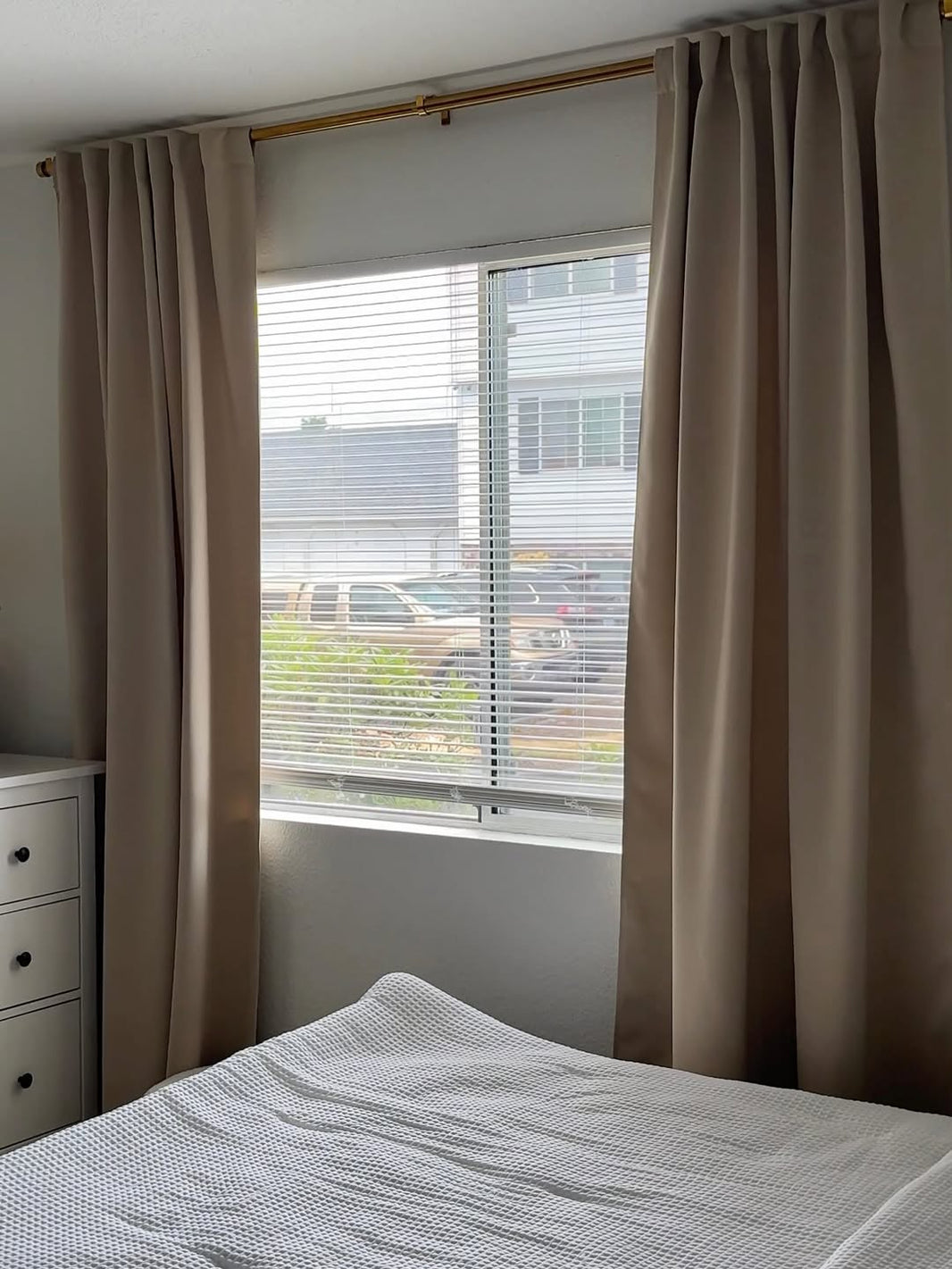
Here's the part most buyers don't expect: even genuinely blackout fabric still lets light in around the edges. Standard curtain rods leave a gap at the top where the curtain meets the wall. The sides bow away from the window frame when a breeze passes. The bottom of floor-length curtains rarely seal against the floor.
Studies suggest these gaps can allow 10–50 lux into a bedroom — enough to suppress melatonin in susceptible individuals even when the curtain fabric itself blocks 100% of direct transmission. The fix requires either a wrap-around curtain rod (which extends past the window frame and curves toward the wall), curtain tape to seal the top gap, or a layering approach combining blackout curtains with a cellular shade mounted inside the window frame.
Width matters too: panels should be at least 1.5× the width of your window so they have enough overlap at the center and can wrap past the frame on each side.
Thermal Performance and Sound Dampening
A useful secondary benefit of thick blackout curtains is insulation. Dense, multi-layer fabric reduces heat transfer through the window, keeping bedrooms cooler in summer and warmer in winter. For lighter sleepers in urban environments, heavier curtains also reduce the transmission of street noise, though they won't approach the performance of proper acoustic panels.
If temperature regulation is a priority alongside darkness, look for curtains with a thermal liner or foam backing. These add bulk but can reduce heating and cooling costs, which offsets the higher upfront cost over time.
Installation for Renters
Standard blackout curtain advice assumes you can drill into walls, but renters often can't. Several approaches work without permanent hardware. Tension rods with wide rubber feet grip window frames without drilling and can hold heavier panels than people expect — check the weight rating before buying. Command-strip curtain rod brackets are another option for lighter panels. For windows where edge gaps are the main concern, adhesive blackout tape sold specifically for curtain installation creates a near-total seal and peels off cleanly.
Our Top Picks for 2026
| Model | Best For | Light Blocking | Construction | Price |
|---|---|---|---|---|
| NICETOWN 100% Blackout Panels | Best overall | 100% (sewn liner) | Triple-weave + black liner | ~$35 |
| Best Home Fashion Thermal | Budget + insulation | 99% | Triple weave | ~$30 |
| Joydeco Linen Blackout | Style-conscious buyers | 95–99% | Linen-look facing + liner | ~$40 |
| IKEA ROSENMANDEL | Certified 100% blackout | 100% (certified) | Polyurethane-coated | ~$50 |
| Deconovo Thermal Blackout | Tight budget | 85–95% | Silver-coated backing | ~$28 |
NICETOWN 100% Blackout Curtain Panels (~$35)
NICETOWN has become one of the most-recommended blackout curtain brands on forums like Reddit's r/sleep and r/ZeroWaste, and for good reason. The panels use a sewn-in black interlining rather than a chemical coating, which means the light-blocking performance doesn't degrade with washing or age. The triple-weave construction adds weight that helps panels hang flat against the window, reducing edge gaps compared to lighter alternatives.
At 52 inches wide per panel, you'll typically need two panels per standard window for adequate coverage and overlap. The panels are available in lengths from 63 to 108 inches, which makes floor-to-ceiling coverage achievable in most rooms. The fabric feels substantial without being stiff, and the grommet top spacing is compatible with most standard curtain rods.
For the price point, the heat and sound insulation is a notable bonus. Reviewers in apartments above busy streets consistently report a noticeable reduction in traffic noise as an unexpected benefit.
Best for: Anyone who wants proven light blockage at a reasonable price without overthinking the decision.
Best Home Fashion Thermal Insulated Blackout Curtains (~$30)
Best Home Fashion's thermal blackout panels have been a consistent mid-tier recommendation for years, and the 2026 lineup maintains that reputation. The triple-weave fabric is densely constructed with a dark central layer that blocks 99% of light — just short of certified 100%, but enough to create a genuinely dark room for most users whose main light sources are streetlights rather than direct sun.
The back tab and rod pocket heading styles give flexible installation options, and the panels come in a wide range of neutral colors that suit most bedroom aesthetics. Thermal performance is strong: the dense fabric creates a dead air layer against the window that measurably reduces heat transfer.
The one caveat is that, like most curtains, edge gaps remain a concern. Pairing these panels with a wrap-around rod adds about $20–30 to the total cost but significantly improves real-world darkness levels.
Best for: Budget-conscious buyers who also want meaningful insulation performance.
Joydeco Linen Blackout Curtains (~$40)
A common complaint about blackout curtains is that effective ones look institutional — thick, dark, heavy. Joydeco has found a workable middle ground with a linen-texture facing fabric over a room-darkening liner. The result looks considerably more elegant than most blackout panels while still achieving 95–99% light reduction.
The thermal insulation is moderate compared to the denser options above, but adequate for most bedrooms that aren't extreme in temperature. The linen look has made these a popular choice for people who want a bedroom that doesn't feel like a cave during daylight hours — the neutral texture reflects ambient light without transmitting it.
Light leakage from the fabric itself is the main trade-off: at 95–99% rather than a certified 100%, these let through slightly more light than the NICETOWN or IKEA options. For most users this won't be noticeable, but highly light-sensitive sleepers may want to layer with a cellular shade.
Best for: Style-conscious buyers who want a bedroom that looks good by day and sleeps dark at night.
IKEA ROSENMANDEL Blackout Curtains (~$50)
IKEA's ROSENMANDEL panels are the most straightforward pick for buyers who want third-party-validated 100% light blockage and don't want to research certification claims. The dense, wool-like fabric has a polyurethane coating that blocks light completely through the panel, and IKEA's product testing is generally more rigorous than many Amazon brands' self-reported specs.
The wool-like texture provides good sound dampening and excellent thermal insulation — useful in bedrooms that face north or get cold drafts in winter. The panels are available in standard IKEA dimensions, so measure carefully before buying; they may not align perfectly with non-standard window sizes.
One practical note: the ROSENMANDEL needs to be ordered through IKEA directly or picked up in-store, which adds friction compared to Amazon delivery. For buyers already making an IKEA run or comfortable with IKEA's online ordering, it's a strong value at the price point.
Best for: Buyers who want certified 100% blackout and are willing to pay slightly more for verified performance.
Deconovo Thermal Blackout Curtains (~$28)
Deconovo is a solid entry point for renters, guest rooms, or anyone who wants to test blackout curtains before committing to a more expensive setup. The silver-coated backing reflects light rather than absorbing it, and the grommet top style makes installation and removal simple.
At 85–95% light reduction, Deconovo panels are honest about their limitations: they're room-darkening rather than true blackout. For rooms that primarily need to block a single streetlight or reduce early morning glow, they'll often be sufficient. For shift workers sleeping in full daylight or highly light-sensitive individuals, the remaining 5–15% light transmission will likely be noticeable.
The trade-off for the lower price is also fabric feel: the silver backing is functional but less premium than sewn-in liners. Washing is fine on gentle cycles, but the coating may show wear sooner than triple-weave alternatives. At $28 for a pair of panels, the value proposition is clear for low-stakes applications.
Best for: Budget buyers, guest rooms, or a first-time test before upgrading to a full light-blocking setup.
Getting True Darkness: The Layering Strategy
Buying the right curtains is only half the battle. Getting a bedroom below the 5–10 lux threshold that research suggests is optimal for melatonin production requires addressing edge gaps.
The most effective approach combines an inside-mount cellular shade (fitted precisely to the window frame, eliminating top and side gaps) with an outside-mount blackout curtain that overlaps the frame by at least 4 inches on each side. This two-layer system is what sleep clinics and occupational health programs recommend for shift workers who need to sleep in full daylight.
If a cellular shade isn't in the budget, a wrap-around curtain rod is the next-best option. These rods extend past the window frame and bend toward the wall, pulling the curtain panels flat against the wall surface on each side. Combined with curtain tape to seal the top gap, this setup approaches the performance of a dual-layer system at lower cost.
The vivavenly sleep guides cover complementary tools — white noise machines, mattress selection, and temperature management — for building a complete sleep setup. The best white noise machines guide is a good next read if noise is also disrupting your sleep.
For tracking whether your changes are actually working, a free Lux Meter app on your phone can measure bedroom lux levels before and after installation. Getting below 5 lux is achievable in most rooms with the right setup.
Frequently Asked Questions
Do blackout curtains actually improve sleep quality?
Research suggests yes, for most people. Studies indicate that even low levels of light during sleep raise heart rate, suppress melatonin, and reduce sleep quality. Blackout curtains reduce light exposure during sleep, which supports more restorative rest — particularly for people in bright urban environments or those who need to sleep during daylight hours.
What's the difference between blackout and room-darkening curtains?
Room-darkening curtains typically block 85–99% of light. True blackout curtains block 100% through the fabric. The distinction matters most for light-sensitive sleepers or shift workers. Either type still allows light in through edge gaps unless you use a wrap-around rod or cellular shade underlayer.
Will blackout curtains make my room too dark to wake up naturally?
Yes — that's the point at night, but it can make mornings harder. A simple workaround is a dawn-simulation alarm clock, which gradually increases light intensity starting 20–30 minutes before your wake time. This preserves the sleep benefits of darkness while still supporting a natural cortisol morning response.
Can renters use blackout curtains without drilling holes?
Yes. Tension rods with high weight ratings (check the product spec — most handle up to 20 lbs) work without drilling and fit standard window frames. For securing curtain tape around the top and sides, adhesive blackout tape is available in strips and peels off most painted surfaces without damage when removed carefully.
How do I know if my curtains are actually blocking enough light?
Use the free Lux Meter app on your phone to measure light levels in your bedroom with curtains closed at night. Below 5 lux is the target for optimal melatonin production. If you're above that, look first at edge gaps (top and sides) — that's where most light enters even with good blackout fabric.
Are blackout curtains worth the investment compared to a sleep mask?
They solve different parts of the problem. A sleep mask blocks light directly at the eye with no edge gaps, making it highly effective for light-sensitive sleepers or travel. Blackout curtains block ambient light that affects partners who don't wear a mask, improve room temperature, and reduce noise. For most households, curtains are the more complete solution; a mask is a practical backup or travel option.
Shop these picks
Related guides